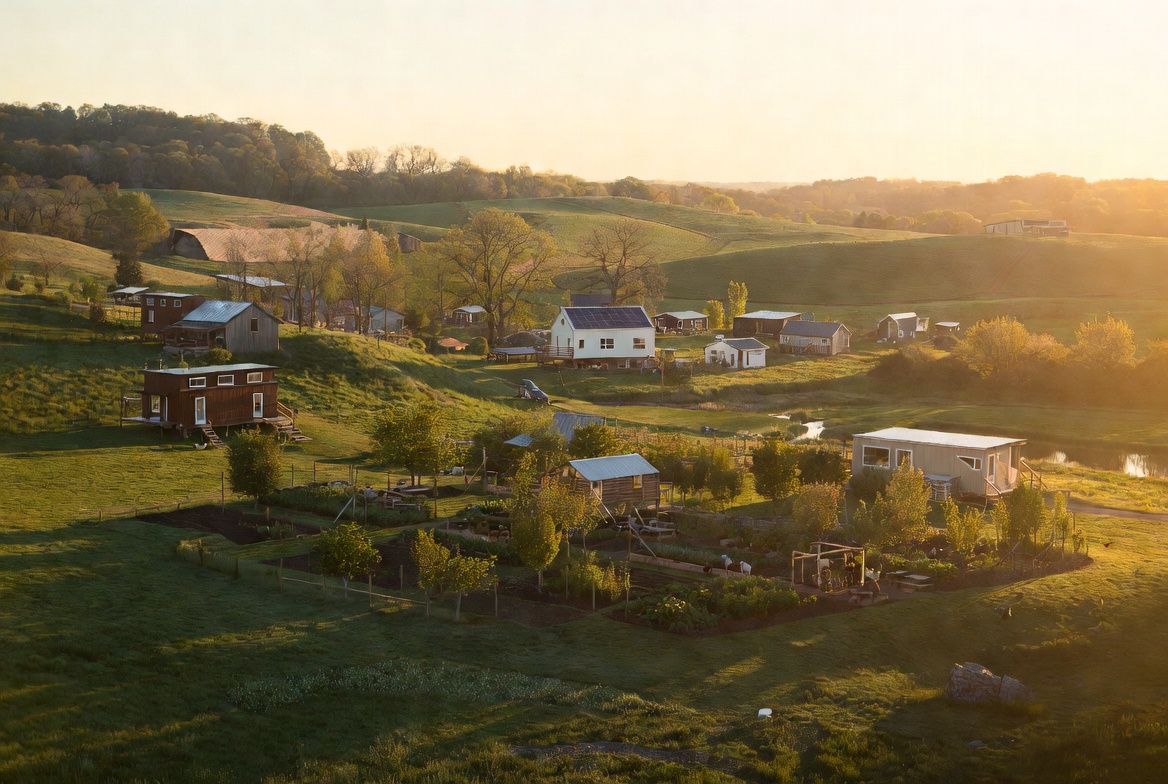

In an era of soaring housing costs, economic uncertainty, and a deepening desire for self-reliance, family compounds are emerging as a powerful model for modern living. A family compound typically involves multiple generations or related households sharing a large rural or semi-rural property, each with private living spaces, whether separate homes, tiny houses, barndominiums, or accessory dwelling units (ADUs), while pooling resources for gardens, livestock, workshops, and communal areas. For homesteaders, this setup isn’t just convenient; it’s a natural evolution of the self-sufficient lifestyle, turning individual efforts into a resilient, multi-generational enterprise.
Multi-generational living has surged in recent decades. Pew Research data shows that the number of Americans in such households quadrupled since the 1970s, reaching about 59.7 million (18% of the population) by 2021. In 2024–2025, multigenerational homes accounted for a record 17% of home purchases, with Gen X buyers leading at 21%. Family compounds extend this beyond one roof, emphasizing privacy plus proximity on shared land—often 5–20+ acres ideal for homesteading.
Homesteaders have long championed independence through gardening, animal husbandry, food preservation, and off-grid skills. A family compound amplifies these efforts. One well, one solar array, or one large barn serves multiple households, slashing costs and labor. Shared childcare frees parents for farm work; grandparents pass down knowledge of canning, foraging, and animal care; and younger adults contribute energy to heavy tasks like fencing or harvesting. This mirrors historical clan living on the land.
Synergies with Homesteading Life
Homesteading thrives on diversity, of plants, animals, and people. On a compound, labor divides efficiently: one household manages the dairy and chickens, another the vegetable plots and orchards, while others handle meat rabbits, bees, or firewood. Surplus production can be sold at markets or stored communally, building food security. Many families report expanding operations thanks to extra hands and land.
Economically, it makes sense amid affordability crises. Pooling resources for land purchase, infrastructure, and tools lowers barriers. A single large property often costs less per family than separate homes, with shared utilities and maintenance. Many compounds incorporate permaculture design, food forests, rotational grazing, and rainwater systems that scale better with group effort, enhancing resilience against supply chain disruptions or inflation.
Socially and culturally, compounds strengthen bonds and legacy. Children grow up immersed in homesteading skills and multi-age interactions. Elders age in place with support. Knowledge transfers organically. Some homesteaders view it as “prepping for life”—creating a system with minimal external dependencies.
A Real-World Example in Progress: One Family’s 15-Acre Vision
On our 15-acre homestead, this model is actively taking shape. My wife and I’s oldest daughter has already lived in her tiny home on the property for nine months out of the year. She is actively expanding the homestead’s microgrid, installing additional solar capacity and battery storage to enable comfortable year-round living. Her contributions not only secure her own independence but also strengthen the entire property’s energy resilience for everyone.
We also have plans to build a tiny home for our other daughter within the next couple of years. And there is hope that our son will one day add his footprint as well, perhaps with his own home, completing a full sibling cluster on the land. This phased approach, starting with one established tiny home, adding infrastructure like the microgrid, then expanding, demonstrates practical homesteading wisdom. It allows testing family dynamics, refining systems, and scaling sustainably rather than building everything at once.
On this property, the tiny homes preserve individual privacy and autonomy while keeping family close enough for daily collaboration on gardens, animals, and maintenance. The microgrid upgrade exemplifies how adult children can drive innovation: younger generations often bring fresh tech skills (solar, batteries, efficient appliances) that benefit the whole compound. As more family members settle in, shared chores become lighter, knowledge deepens, and the homestead’s output grows from expanded vegetable beds to larger livestock rotations.
Benefits and Real-World Wins
Financial Efficiency: Shared infrastructure (wells, septic, barns, microgrids) and bulk purchasing cut expenses dramatically.
Labor and Care Networks: Built-in support for childcare, eldercare, and farm work.
Self-Sufficiency Boost: Larger scale supports diverse enterprises and value-added products.
Emotional Resilience: Stronger family ties combat isolation and create shared purpose.
Challenges and Mitigation Strategies
Success requires intentionality. Privacy is preserved through separate entrances, kitchens, and clear boundaries. Conflicts over money, chores, or vision demand upfront agreements, perhaps via an LLC, family trust, or written covenants on maintenance, inheritance, and dispute resolution.
Zoning and legal considerations vary: many rural counties support multiple dwellings on agricultural land, especially when framed as farm-related housing, but always verify local rules for tiny homes on foundations, septic systems, and access. Financial transparency prevents resentment. Honest conversations about values and exit strategies are essential.
Getting Started on Your Compound
Begin with visioning: Align on goals (food production, off-grid resilience, legacy land). Scout acreage with good water access, road frontage, and buildable sites. Involve professionals for surveys, permits, and estate planning. Start small, as with one tiny home and microgrid improvements, then expand. Design thoughtfully: cluster homes around a central commons while maintaining sightlines for privacy. Incorporate universal design for aging in place.
Many homesteaders in states with supportive rural zoning are successfully building these compounds, using tiny homes as flexible, affordable entry points.
A Timeless Model for Tomorrow
Family compounds represent a return to roots with modern twists—tiny homes, microgrids, and permaculture. For homesteaders like the family on their 15 acres, they embody the movement’s ethos: reclaiming control over food, energy, community, and future. As housing pressures mount and the desire for meaningful connection grows, this model offers security, fulfillment, and a living legacy.
In the words of many practitioners, it’s not about escaping the world but building one where your family thrives together. Whether starting with one daughter’s tiny home and microgrid upgrades or dreaming of all three children rooted on the land, the compound turns homesteading dreams into a sustainable, multi-generational reality. The soil is rich, the hands are many, now is the time to plant.